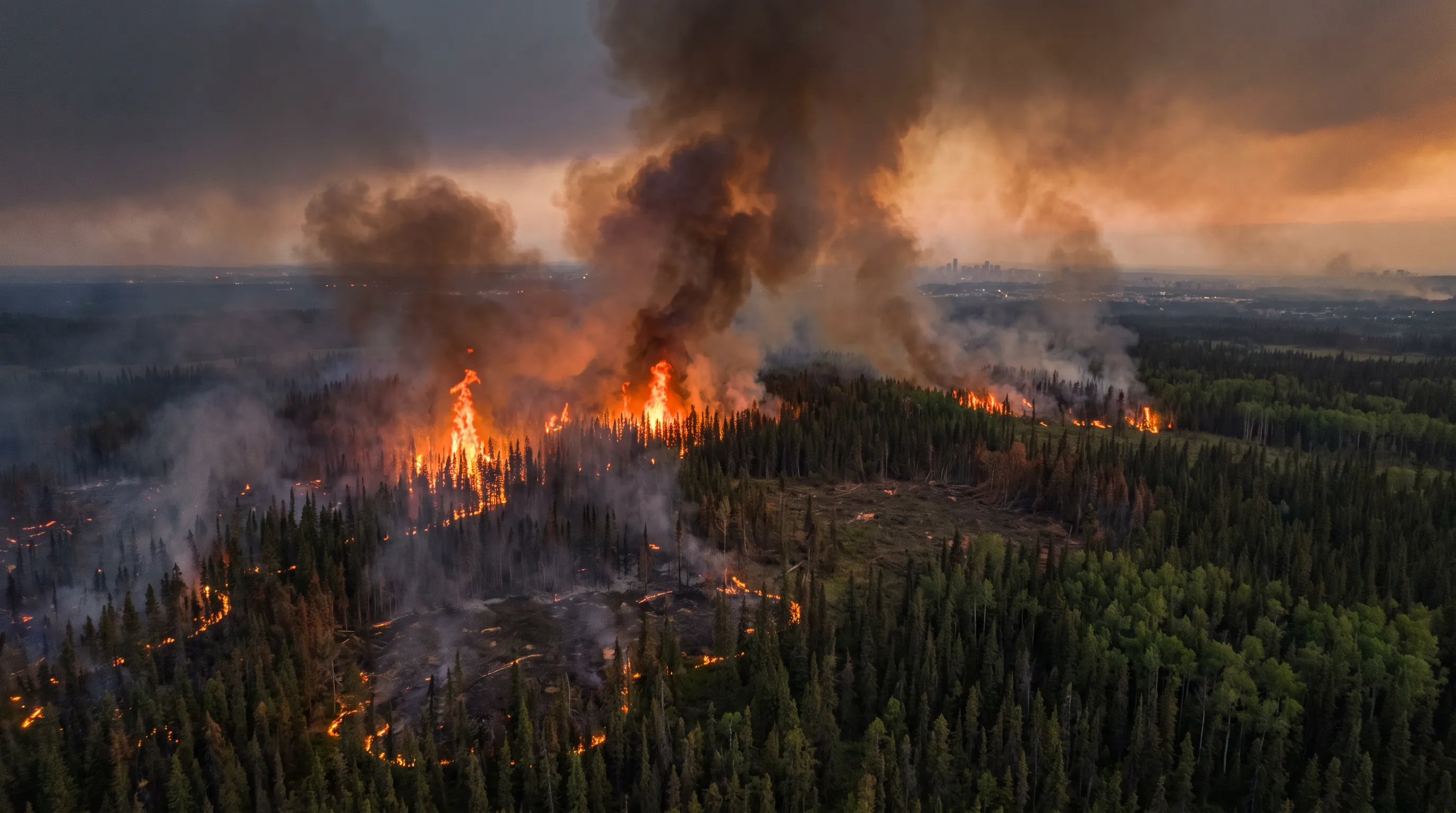
Right now, Northern Ontario is burning. So is a wide swath of the western United States. Communities that existed a month ago are gone. Highways have closed to evacuation traffic. And hundreds of kilometers from the fire lines, air quality in Toronto, Ottawa, and major U.S. cities has crossed into hazardous territory — not because those cities are on fire, but because the smoke doesn’t need a passport to travel. People who have never seen a wildfire are being told to stay indoors and check an air quality index like it’s a weather forecast now.
This is not a once-a-decade anomaly anymore. It is July, again, and it is happening, again. And every year the same conversation repeats: how did a fire that started small become a fire that made the news in a city four provinces or three states away?
Years of Progress, Erased in Days
Governments, companies, and individuals have spent the better part of two decades investing in sustainability — emissions targets, reforestation programs, carbon offsets, cleaner grids. Real money, real commitments, real progress. And then a single wildfire season torches through hundreds of thousands of hectares of forest, dumps megatons of carbon and particulate matter into the atmosphere, and erases years of that progress in a matter of days.
That is not a failure of effort. Nobody is choosing not to care. It is a failure of response speed, and it is happening because the way we fight fires has barely changed while the fires themselves have gotten faster, hotter, and more frequent.
We Fight Fires the Same Way We Did Decades Ago
A wildfire roughly doubles in size every ten to twenty minutes in its early stages. A one-acre ignition can become a four-thousand-acre fire in about two hours if nothing intervenes. That math has not changed. What has not kept pace with it is the response.
Conventional aerial firefighting still runs on a model built decades ago: crewed water bombers and helicopters staged at a handful of regional airbases, dispatched after a fire is reported, confirmed, and prioritized. By the time an aircraft is airborne and on-scene, the fire has often already passed the point where a handful of accurate water drops could have contained it. The technology of the aircraft has improved. The posture — reactive, centralized, distant from the ignition point — has not.
That gap between ignition and first response is the entire ballgame. It is the difference between a fire that gets contained at two acres and a megafire that closes highways, destroys towns, and pushes smoke into cities that will never see a flame.
The Technology That Closes the Gap
Ryze Fire was built around one idea: the fire is won or lost in the minutes after ignition, and the only way to act in those minutes is to already be close. Instead of a small fleet of crewed aircraft staged at a distant airbase, Ryze Fire is a rapid-response VTOL water bomber platform pre-positioned at strategic locations across high-risk forest zones — carrying up to 2,000 liters of water or retardant, capable of vertical takeoff with no runway required, and able to reload from any nearby water source.
The platform is designed to deploy in coordinated grid formation, not as a single asset responding to a single alarm. That means coverage across a high-risk region that no traditional aerial system staged at one or two airbases can match, and it means the aircraft closest to a new ignition can be in the air within minutes, not hours. Rapid response, at the scale a real fire season actually demands.
This is not a hypothetical for some distant future. The aircraft class exists, the VTOL and autonomous-operation technology exists, and the regulatory pathways for this kind of dual-use aviation are already being built out across multiple jurisdictions. The real question in front of governments, forestry departments, and emergency management agencies right now is not whether this technology can work. It’s whether it gets deployed before or after the next fire season does the same damage this one is doing.
The Smoke Doesn’t Stay Where the Fire Is
It is worth repeating, because it is the part that keeps getting missed in the response planning: air quality in Toronto, Ottawa, and major U.S. cities is being hit right now by fires burning hundreds of kilometers away. Wildfire smoke is not a local problem contained to forestry regions. It is a public health event that reaches people who will never see a fire line, who have no say in how quickly suppression capacity gets deployed, and who are nonetheless breathing the consequences of a slow response somewhere else.
That reframes the stakes. Faster wildfire containment isn’t only a forestry issue or a rural infrastructure issue. It is an air quality and public health issue for every downwind city, which is most of them. The technology to intervene in the minutes that matter exists today. What’s missing is the decision to deploy it before the next ignition, not after.
See the rapid-response platform built for this moment
Ryze Fire is built for the minutes after ignition, when containment is still possible. If you’re a government agency, forestry department, or emergency management team evaluating rapid-response wildfire technology, we want to talk.